EBIC drives scientific and regulatory dialogue at BWC 2025
December 2025
As an official partner of the Biostimulants World Congress 2025, EBIC played an active role in scientific, regulatory and market discussions throughout the three-day international event in Barcelona. With strong representation from its Board, Secretariat and Membership, EBIC participated in regulatory workshops, conference sessions and panel discussions focused on the future of plant biostimulants and the vital role they play in sustainable agriculture.
Sara García Figuera’s presentation at the Regulatory Workshop provided an overview of the current EU regulatory framework and EBIC’s ongoing engagement with the European institutions. She also outlined why 2026 will be a critical year for the biostimulants sector, particularly in relation to future developments of the EU Fertilising Products Regulation (FPR), highlighting the importance of collective industry advocacy through EBIC.
Patrick du Jardin opened the main conference with a call to continue disentangling the effects of plant biostimulants, to challenge regulatory boundaries where necessary, and to broaden the concept of plant nutrition by incorporating both nutrients and organic substances that enable key physiological functions.
Research into the mode of action and field performance of plant biostimulants were key topics throughout the event, with presentations from many of the lead academics in this area, such as Pierdomenico Perata, Jaroslav Nisler, Giuseppe Colla, Petronia Carillo and Antonio Ferrante. Both the Science & Technical Track and the Strategy & Commercial Track featured presentations or panel discussions including several EBIC members, such as Board members Alice Toderi, Carlos Rodriguez-Villa Forster, Jose Nolasco, Marco Rosso and Massimo Toni.
The Regulatory & Policy Session on December 3rd, moderated by Elodie Lebastard from the EBIC Secretariat, brought together EU and US regulators to discuss how science and policy can evolve together to support sustainable farming solutions. Theodora Nikolakopoulou of the European Commission presented upcoming legislative developments, for example for microbial plant biostimulants under the FPR. In parallel, Nick Young from the California Department of Food and Agriculture offered an update on US regulatory developments, mentioning a list of 200 microorganisms in recognised plant biositmulants. The panel discussion that followed illustrated the growing need for international alignment on rules around plant biostimulants.
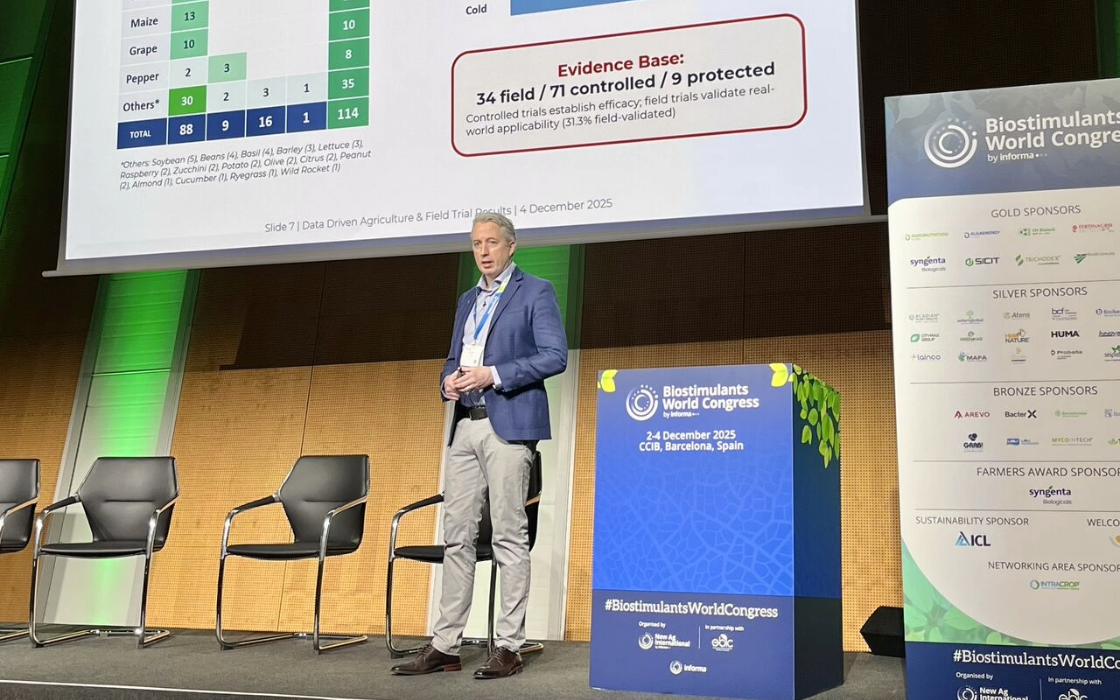
Another EBIC highlight at the BWC was the presentation by David Barton of the EBIC Secretariat of a large-scale meta-analysis on biostimulant performance under abiotic stress. Drawing on 114 trials across 20 crops, and 4 abiotic stress types, and open field, protected and controlled conditions, the analysis provided compelling evidence that biostimulants help protect yield under stress and represent a valuable tool for climate adaptation in agriculture.
The congress concluded with Patrick Brown synthesising key scientific and strategic messages: the growing urgency of mitigating the impact of extreme weather events on crops, the central role of soil health, and the challenge of preventing regulatory boundaries from constraining innovation in plant biostimulants, among others.
All conference participants also enjoyed the numerous networking opportunities throughout the event, which gathered 1500 attendees and provided multiple chances to make connections, from the opening reception to the breaks and the many booths across the exhibition floor.
Through its partnership and active participation, EBIC once again reaffirmed its mission to promote science-based regulation, evidence-based claims and global policy alignment to support the responsible growth of the plant biostimulants sector.