EBIC Responds to EU Commission’s roadmap towards Nature Credits
October 2025
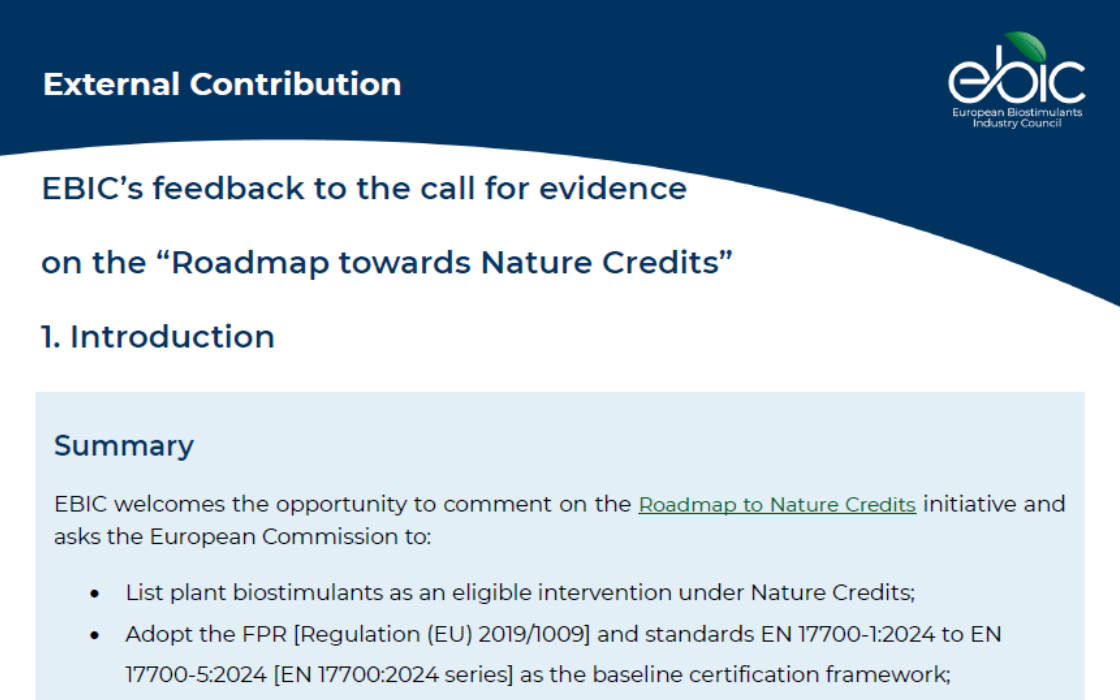
In the context of the European Commission’s Roadmap towards Nature Credits, EBIC submitted a detailed response on the importance of plant biostimulants in providing science-based, measurable contributions to Europe’s sustainability goals.
In this contribution, EBIC asked the Commission to:
- List plant biostimulants as eligible interventions under the Nature Credits framework;
- Adopt existing legislation and standards (namely the Fertilising Products Regulation) 2019/1009 and the EN 17700:2024 series as the baseline for certification;
- Implement proportional, outcome-based Monitoring, Reporting, and Verification (MRV) systems linked to proxy indicators;
- Include biostimulants in Horizon Europe and LIFE pilot calls post-2026, to validate methodologies and key performance indicators; and
- Ensure EBIC representation in the forthcoming expert group on Nature Credits.
Plant biostimulants are defined in EU law by four key functions: enhancing nutrient use efficiency; improving abiotic stress tolerance; boosting crop quality; and increasing nutrient availability in the soil or rhizosphere. They are already recognised as fertilising products supported by harmonised European standards. These functions align directly with the five outcome areas of the Roadmap: soil fertility, water quality, climate mitigation, biodiversity and food security.
“Biostimulants are not a silver bullet, but they play a proven role in supporting regenerative agriculture,” said David Barton, EBIC Secretariat. “When combined with practices like reduced tillage or crop rotation, they deliver measurable, certifiable improvements to ecosystems while reducing farm-level vulnerability to climate change.”
Scientific evidence shows that biostimulants can deliver valuable outcomes under specific conditions and use patterns. For example, peer-reviewed papers have reported:
- Nutrient efficiency: fertiliser savings of 20–25% with no yield loss in barley and grassland, and NUE gains of 30–60%.
- Environmental impact: 20–30% lower nitrate leaching and up to 22% fewer nitrous oxide emissions in reduced-nitrogen regimes.
- Biodiversity and soil health: increased microbial diversity, enzymatic activity and nutrient cycling.
- Yield stability: greater tolerance to drought, heat, frost and salinity, safeguarding food security.
These outcomes will vary depending on factors such as product type, crop, soil, and management practices, as is the case with all agronomic inputs. However , a growing body of peer-reviewed evidence shows that biostimulants can contribute meaningfully to nature-positive agriculture when used appropriately.
Biostimulants provide a practical bridge between regenerative ambition and economic resilience. By improving nutrient-use efficiency and stabilising yields, they help reduce environmental impact while lowering financial risk. This capacity to de-risk production makes them a strategic enabler within broader sustainability transitions.
Climate-related farm losses already exceed €28 billion annually in the EU, and unfortunately this number is projected to rise to €46 billion by 2050. Biostimulants can play a crucial role in mitigating this rise, by helping a wide range of crops deal with stress and optimising input use. Biosimulants directly address the risk factors identified in the Commission’s hazard–exposure–vulnerability framework referenced in the Roadmap.
As stated in EBIC’s contribution, “With existing legislation, standards, and field evidence, they are well-positioned to contribute credibly to the delivery of measurable outcomes under the EU Nature Credits framework”.