EBIC’s annual Summit sees launch of new manifesto
June 2024
The 2024 EBIC Summit brought together members and invited stakeholders including farmer representatives, food chain leaders, policymakers, NGOs, academics, and industry to discuss how to work together to create opportunities for more resilient food systems in the face of volatility and the vital role that biostimulants play. Attendees repeatedly raised the need for the wider agrifood industry to talk to each other and work together to make the most of available technologies, validating the value of the Summit.
The event was opened by EBIC President Arne Pingel and Vice-President Carlos Rodriguez-Villa Förster, alongside the day’s moderator, Natasha Foote. They warmly welcomed all in attendance, reiterating the aims for the day and introducing the two sub-themes, ‘Ensuring food security and quality in times of turbulence’ and ‘Supporting farmers in times of turbulence’.
Christine Tacon CBE, Member Director at the Co-op Group and the UK’s first Groceries Code Adjudicator, delivered the keynote: ‘How do we break down silos and build bridges to deliver agrifood transformation?’ She shared her experience of farmers being ‘defensive and suspicious of new products’, but stressed that integration of technologies, techniques and innovations are key. Creating a safe place of trust and confidence for us to share data and knowledge is vital to address these issues. She went on to discuss the necessity for farmers to be active participants in the march forward and be incentivised to do so, with farming unions on side to support this evolution and the integration of new technology. Education, communication and regulation should be at the heart of progress, moving everyone in the agrifood chain forward together.
Session one began with an address from Katharine Teague, Group ESG Director, ABF Sugar, and Vice President of the food industry’s SAI Platform, under the title, “Ensuring food security and quality in times of turbulence: Where farmer and food chain interests meet”. The talk built on the industry’s desire to build connections throughout the agrifood value chain. Katharine shared her view that conditions have come together for biostimulants to have their ‘moment,’ but she noted that users need more data and demonstrations to understate which products are effective and under which circumstances. In an increasingly volatile world, biostimulants can offer a stability and certainty that other products simply do not, but the understanding of them is still not where it needs to be.
The subsequent panel, “Working towards the common cause of robust agricultural and food supply chains” was moderated by Natasha Foote, freelance journalist, and featured: Bill Wirtz, Senior Policy Analyst, Consumer Choice Center; Will Surman, Deputy Director General and Director of Strategic Communications, Public Affairs and ESG, FoodDrinkEurope; Antonis Angeletakis, Director for Biostimulants, Yara International; Patrick Pagani, Deputy Secretary General, COPA-COGECA and Marc Billiet, Senior Adviser for Goods Transport, International Road Transport Union (IRU).
Conversation focussed on how we define a robust agrifood chain and what it takes to ensure one. Most notably, supporting the future of farming was at the forefront of thinking, with careful consideration given to how we attract young people to farming, promote female leaders and offer fair remuneration for those that come to the profession. To do this, we must empower them with the agility and flexibility they require to become more adaptable, especially in times of crisis.
Robust supply chains need communication, transparency, and collaboration but also regulation and better governance throughout the food chain so that value is distributed fairly and to ensure resilience in the face of increasing volatility.
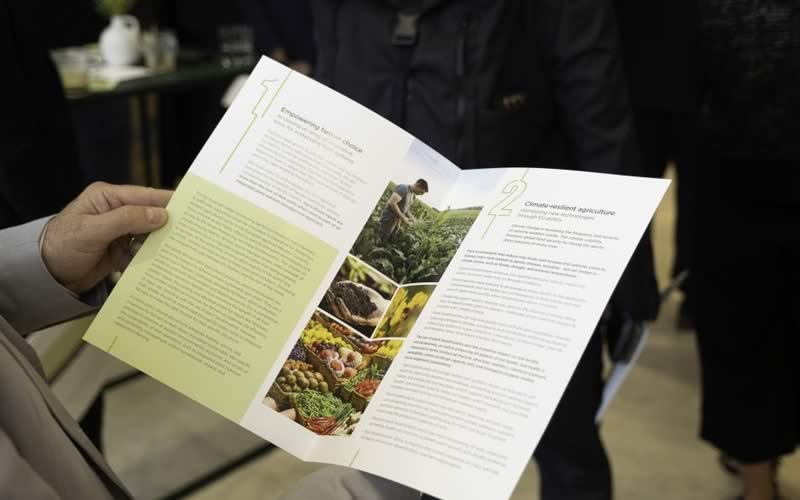
Towards midday, EBIC launched its brand-new Manifesto. Following the European Elections, an opportunity has arisen for constructive change. This policy manifesto serves as a blueprint for EU policymakers, stakeholders, and the broader community, highlighting the urgent need for transformative action in the agricultural sector during the next EU Parliamentary mandate and Commission Work Programme for 2024-2029.
This was followed by our two expert roundtables. The first, “Managing risk from climate”, was moderated by Chris Hegadorn, Adjunct Professor in Global Food Politics, Science Po University and featured: Pascal Forrer, President of AIAG (Crop Insurers Association) and former CEO of Schweizer Hagel; Ana Rocha, Director of EU’s Agri & forestry Related Policies at the European Landowners’ Organisation; Moshi Berenstein, European Irrigation Association (EIA), President & Managing Director of Netafim France; César González, Manager Public Affairs at Euroseeds; and Mark Palmer, Co-Leader of EBICs Agronomy Project Team and Commercial Director of IntraCrop.
We heard about passion, ingenuity, and willingness from farmers and the industry; but climate change is not making it easy. We need collaboration across the food chain to make our food systems more resilient in the face of increasing volatility, and biostimulants are an exciting new tool. We know this can be done where necessary, as seen through the pandemic, so it is time to acknowledge that we are in a new era of crises; it’s not a question of ‘if’, but of ‘when’ and ‘what’. Preparedness will be vital to secure the future for growers and the wider food chain, as well as the population that relies upon it.
The parallel roundtable, “Working together to enable farmers as agile entrepreneurs”, was moderated by Natasha Foote and featured: Eduardo Cuoco, IFOAM Organics Europe; Louis Gauthier, Doriane; Glauco Bertoldo, Agricultural Attaché at the Mission of Brazil to the European Union; and Deirdre Wall, EBIC Member, Brandon Bioscience. The panel stressed the need to continue to attract talent and skills to the sector and provide competitiveness at farm, European and global level. The experts also spent time emphasising the importance of healthy soils and the balance between all three pillars of sustainability. Discussion persists around how best to incentivise data collection and remunerate farmers for it, but it is vital we collect it to demonstrate the impact biostimulants have on improving soil quality, resilience to climate stress and farmer competitiveness.
Across the two roundtables, there were common points about the need for trust and collaboration to enable the incorporation of various innovations and farmer-led experimentation, integrated use of data, fostering innovation and more.
They were followed by the session two address on “Helping the next generation of farmers thrive despite volatility”, given by Jesse Schevel, a young dairy farmer from the Netherlands and Head of the Brussels Office of Glastuinbouw. His words, “As a farmer, I have the choice between eating or being eaten,” resonated with everyone in the room, and his plea for farmers to have access to alternative technologies, including biostimulants, as well as sources of energy, crop protection products, finance and land struck a chord with all in attendance. Jesse identified many of the pressing challenges facing our farmers and our food systems, highlighting that access to investment and alternative technologies were at the top of his list, closely followed by access to land and credit so that we can continue to grow and support leaders for the future.
Our closing stakeholder dialogue, “Better cooperation to support farmers in times of turbulence.”, was again moderated by Natasha Foote. Sitting on the panel was: Fabien Santini, Acting Head of Unit, Governance of the agri-food markets and secretariat of the European Food Security Crisis preparedness and response mechanism (EFSCM) at DG AGRI, European Commission; Jelte Wiersma, Secretary General of CEMA (European Agricultural Machinery Association); Marco Rosso, Working Member of EBIC’s Farm-to-Fork Project Team, Global Head Sustainability and Corporate Affairs Biologicals and Seedcare at Syngenta Biologicals; and Jesse Schevel from Glastuinbouw Nederland. The panellists noted that we have successfully built relationships during recent crises and that as a result, our responses have become more agile. There is still more work to do, and it is vital to have regulations that enable farmers access to new, safe and effective technologies.
There have been some important steps forward in EU regulation in recent years, such as the Fertilising Products Regulation, but there is much more that is yet to be accomplished.
The question remains whether we can we move fast enough to meet the challenges. There are historical precedents, like the shift from horses to mechanisation. But machinery adapted to farmers’ exact needs has a price, and farmers are having more difficulties securing loans. We need to build long-term relationships, both so farmers have clarity for investment, but also because many of the choices that farmers make lock them in for a long-time.
The day ended with closing remarks from the EBIC board, and a CEO fireside chat for members, where time was taken to reflect on all that the stakeholders had contributed throughout the day. Many insightful topics and thoughts were shared, but one clear conclusion was drawn from the day’s discussions: we need to continue conversations, meet with all involved, and better understand how our technologies, frameworks and tools can work together; for the benefit of business, farmers and consumers alike.
The manifesto
As we stand at the cusp of a new EU Parliamentary mandate and Commission Work Programme for 2024-2029, it is imperative that bold and transformative actions ensure the sustainability, resilience, and competitiveness of our agricultural systems. With climate change and soil degradation posing a very real threat to food security and farmer livelihoods, EBIC’s manifesto puts forward a vision that leverages the power of plant biostimulants to address these issues head-on.
Plant biostimulants are part of the family of fertilizing products and stimulate natural plant processes; they can improve nutrient use efficiency, enhance crop quality, and increase tolerance to abiotic stressors
such as drought and extreme temperatures. In an era of climate volatility, these attributes make biostimulants indispensable tools for farmers. If Europe formally adopts biostimulants, they will support farmers in their transition towards more sustainable agricultural practices, enhancing competitiveness and ensuring food security.
Climate change poses a severe threat to global food security. Plant biostimulants mitigate these risks by enhancing crop resilience to abiotic stresses such as floods, droughts, and extreme temperatures. The global biostimulants market is therefore poised for significant growth, particularly in Europe. However, to realise this potential, the EU regulatory and policy landscape must foster innovation and facilitate the adoption of these new technologies. It is crucial to reduce regulatory barriers and streamline the market entry of biostimulant products to create a level playing field for all farmers.
Farmers need access to a broader toolbox and the freedom and understanding to select the best options for their specific conditions, adapt their practices and optimize the use of agricultural inputs. The EU must invest in and leverage its agrifood ecosystem to benefit farmer livelihoods and enhance market competitiveness. By ensuring that innovative biostimulant products reach farmers promptly, we can help to close the competitivity gap between EU farmers and their global counterparts.
The geopolitical landscape underscores the need for the EU to boost its strategic autonomy in agricultural production. Plant biostimulants enhance nutrient uptake and optimize crop yields, thereby improving food security and farmer incomes. By reducing nutrient losses and maximizing the efficacy of inputs, biostimulants also help mitigate the environmental footprint of agriculture.
To ensure that farmers can fully benefit from the advantages of biostimulants, we urge EU policymakers to:
- Facilitate and accelerate the safe market entry of various biostimulant technologies, particularly those derived from animal by-products or containing micro-organisms.
- Incentivize and support the uptake of sustainable technologies such as biostimulants through targeted EU policy tools, including in the CAP.
By embracing biostimulants, we can create a sustainable, resilient, and competitive agricultural sector that meets the needs of the present and future generations.
Ends