EBIC Summit 2026
EBIC Summit 2026: Exploring the Imperatives for Competitiveness, Security and Resilience in EU Agriculture
The 2026 edition of the EBIC Summit brought together business leaders, policymakers, farmers and agrifood stakeholders in Brussels to explore one of the most pressing questions facing European agriculture today: how can competitiveness, security and resilience be strengthened in an increasingly uncertain world?
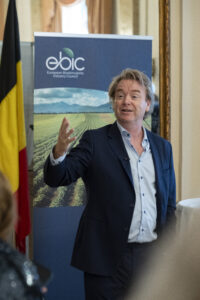
The EBIC Summit began on 9 June with a welcome reception at the Cercle Royal Gaulois, featuring a keynote address from renowned Irish economist, author and podcaster David McWilliams. His thought-provoking reflections on Europe’s place in a changing world offered a perspective rarely heard at agrifood events: he connected economics, society and even poetry to the challenges facing agriculture. By drawing unexpected parallels between the biostimulants sector and the importance of imagination, creativity and long-term thinking, he delivered a refreshing and inspiring opening that set the tone for the discussions ahead.
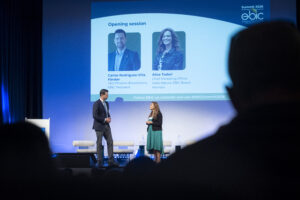
The following day, under the moderation of Christine Gould, Founder of GIGA Futures and Thought For Food, the Summit officially opened with welcoming remarks from EBIC President Carlos Rodríguez-Villa Förster and Alice Toderi, EBIC Board Member.
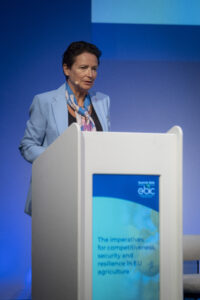
The morning was opened by keynote speaker Geneviève Pons, Director General of Europe Jacques Delors. Drawing on decades of experience at the heart of European policymaking, she reminded participants that agriculture’s challenges cannot be solved in isolation. What was particularly striking was her emphasis on dialogue and consultation between farmers, industry, policymakers and food chain stakeholders as the foundation for effective solutions. Her intervention reinforced a recurring theme throughout the Summit: that any successful transition must balance the economic, social and environmental dimensions of sustainability. She recognised plant biostimulants as one of the tools that can help farmers navigate the multiple and overlapping challenges they face while supporting a more resilient agricultural system.
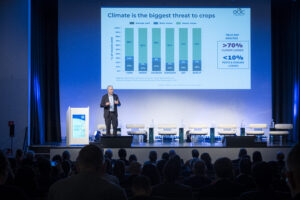
This message was complemented by a plenary presentation from David Barton, Senior Consultant at Prospero & Partners, who explored The Climate Risk Reality: the economics of resilience. One of the strongest takeaways from the session was the need to rethink how climate-related crop losses are viewed. With annual crop losses linked to climate stresses already estimated at €17.4 billion across European agriculture, David highlighted that climate risk is no longer a future challenge—it is today’s reality. Rather than seeing crop losses simply as weather events affecting individual farms, he demonstrated how their impacts ripple across the entire food chain, affecting businesses, markets and consumers alike. The discussion made clear that resilience is no longer only an environmental objective, but an economic necessity. Importantly, David presented calculations that plant biostimulants could help EU farmers recover around €1 billion of their harvests that would otherwise be lost to drought and other climate stresses, and that figure does not include prevent climate-related reductions in loss or reduced nutrient use efficiency.
One of the Summit’s most distinctive features was its three parallel joint problem-solving sessions. Moderated by David Barton (Prospero & Partners), the session “Resilience and security of harvests in the face of climate variability” brought together Rowan Douglas CBE (Centre for Climate Finance & Investment, Imperial College London), Meghan Sapp (European Alliance for Regenerative Agriculture), Fatih Ermis (Nestlé Zone Europe) and Joseph Gridley (Soil Association Exchange) to discuss how climate risks are increasingly affecting agricultural production and supply chains. A key takeaway from the discussion was that climate resilience can no longer be viewed solely as an environmental challenge—it is rapidly becoming a business, supply chain and investment imperative, requiring coordinated action across the agrifood sector.
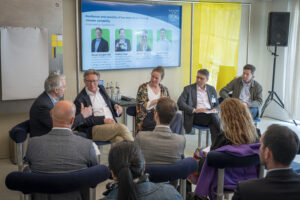
The second parallel joint problem-solving session, “How Nutrient Circularity and Efficiency Enhance Food Chain Resilience” was moderated by Kristen Sukalac (Prospero & Partners), and brought together Oliver Hatfield (Argus Media), Azucena Mainar Navarro (Fertinagro Biotech), Edoardo De Paola (COTANCE) and Max Schulman (Copa-Cogeca). Bringing perspectives from agriculture, industry, trade and sustainability, the discussion explored how Europe can make better use of the nutrients already available within its food system. At a time of geopolitical tensions, energy price volatility and supply chain disruptions affecting fertiliser and feed markets, the panel highlighted nutrient circularity and efficiency as important tools for strengthening food chain resilience, reducing dependencies and supporting a more sustainable and competitive agricultural sector.
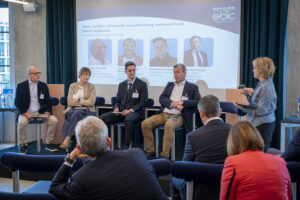
The third parallel joint problem-solving session, “How Agriculture and Bioeconomy Innovation Can Drive Competitiveness and Resilience,” was moderated by Christine Gould and brought together Marco Rupp (Bio-Based Industries Consortium), Paul Clements-Hunt (The Blended Capital Group), Julien Honoré (Roquette), Anne Marchadier (European Landowners Association) and Robert de l’Escaille (Agriland). Drawing on perspectives from industry, finance, land management and the wider bioeconomy ecosystem, the discussion examined how innovation, investment and regulation can either accelerate or hinder the development of Europe’s bio-based economy. A key message emerged from the debate: Europe already possesses the resources, expertise and innovative capacity needed to lead globally, but unlocking the full potential of the bioeconomy will require enabling regulatory and investment frameworks that allow innovation to scale for farmers, industry and investors alike.
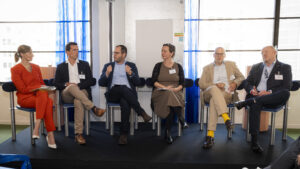
Bringing together a uniquely diverse group of speakers—from farmers, to food manufacturers, sustainability experts, financial specialists, bioeconomy leaders and agribusiness executives—the discussions explored how to strengthen harvest resilience in the face of climate variability, improve nutrient circularity and efficiency, and unlock innovation across agriculture and the bioeconomy. What made these sessions particularly valuable was not only the topics themselves, but the variety of perspectives represented in the room. Despite approaching challenges from different angles, a common conclusion emerged: building resilience will require stronger collaboration across the entire agrifood value chain, alongside innovative solutions that support both productivity and sustainability.
One of the most timely discussions of the day was the panel entitled “What does the re-organisation of global trade and geopolitics mean for agriculture?” Bringing together perspectives from Europe and around the world, the discussion examined how evolving trade patterns, geopolitical tensions and economic uncertainty are reshaping agriculture and food systems. A particularly interesting takeaway was the recognition that we are operating in a state of “perma-crisis”, requiring a mindset shift focused on efficiency, resilience and diversification. The panel highlighted that food security and economic security can no longer be viewed separately. Ensuring farmers have both will be essential to maintaining a competitive and resilient agrifood sector in an increasingly interconnected world.
Panelists: Henrique Pacini (UNCTAD), Pierre Merle (UPL), Nazar Bobitski (Ukrainian Agribusiness Club), Louis Hinzen (FoodDrinkEurope), Vinicius Lemes (Agrolink Brasil), and Venkatesh Palani Samy (Embassy of India in Brussels).
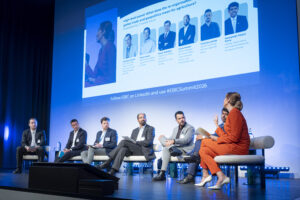
The Summit concluded with the EBIC Fireside Chat, an interactive dialogue reserved for EBIC members and invited guests. Rather than a traditional panel discussion, the Fireside Chat is designed to be a genuine live conversation between senior industry leaders and participants. This created a rare opportunity for attendees to contribute directly to the discussion, share ideas, challenge assumptions and engage with high-level stakeholders on some of the sector’s most pressing issues. The result was a dynamic and candid exchange that perfectly captured the collaborative spirit of the Summit.
Fireside chat panelists: Karina von Detten (Huber AgroSolutions), Renzo Domenico Pedretti (Corteva Agriscience), Sergi Barrull (SICIT Group) and Enrico Boccaletti (Acadian Seaplants).
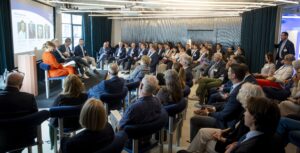
It is a pleasure to know that this year’s Summit sparked new ideas, inspired fresh thinking and generated meaningful conversations among participants. As the sector continues to navigate an increasingly complex landscape, the discussions in Brussels demonstrated the value of bringing together diverse perspectives to identify solutions and opportunities.
EBIC already looks forward to building on the momentum created during the event, advancing the ideas discussed and continuing the conversations that began at the Summit.
The next major industry-wide milestone will be the Biostimulants World Congress, taking place this year in Sacramento, California, from 30 November to 3 December 2026, organised by New AG International in partnership with EBIC. We look forward to bringing the global biostimulants community together once again and continuing the dialogue on innovation, sustainability and resilience in agriculture.
We can’t wait to see you all there.