EBIC Summit 2025
2025 EBIC Summit: unleashing innovation in a fragmented world
On 12 June 2025, EBIC brought together stakeholders from across the agrifood chain for its annual Summit in Brussels, under the theme ‘Making competitive and sustainable agriculture a reality’. Amidst geopolitical uncertainty, climate stress and fragmented policymaking, the Summit focused on the urgent need to secure food supplies while enhancing sustainability and competitiveness. Collaboration, practical innovation and farmer empowerment emerged as essential pillars for future resilience.
Held at Sparks Meetings Brussels, with a welcome reception the evening prior at Cercle Royal Gaulois, the Summit convened entrepreneurs, policymakers, and industry leaders to generate forward-looking ideas and partnerships. The reception featured a keynote talk by Ian Goldin on “Global Change: Renaissance or Storm,” in which he reflected on how turbulent, disruptive, and contested the Renaissance period was, drawing thought-provoking parallels with the global transformations we are experiencing today.
Opening remarks and keynote
The Summit opened with a welcome from EBIC President Carlos Rodriguez-Villa Förster and Director-at-Large Alice Toderi, who urged attendees to view the Summit as the beginning of a broader dialogue. Giuseppe Natale, co-founder of Valagro, gave a powerful keynote reflecting on his roots in farming and called on Europe to take ownership of sustainable agriculture: “Innovation must deliver real tools to the farm gate. Sustainability is not a trend. It’s a necessity.”
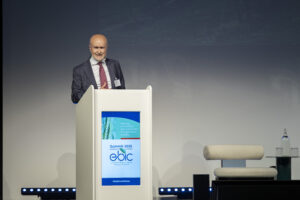
Giuseppe Natale
Morning plenary: from innovation to application
The first plenary explored the gap between innovation and market access. Giuseppe Natale and Paul Mullins discussed how new technologies must move beyond patents to deliver value in the field. A following panel moderated by Natasha Foote featured Mark Palmer, Paula de Vera, and Nicolas Willaume, who examined soil health, nutrient use efficiency and stress tolerance. The discussion highlighted the need for adaptable regulation and advisory services that connect innovation with practical farmer action.

Mark Palmer, Paula de Vera, and Nicolas Willaume
Parallel problem-solving sessions
Attendees then split into three parallel sessions to tackle pressing regulatory and market challenges.
The session on Circular Economy and Animal By-Products was moderated by Antonis Angeletakis, with contributions from Jacques Pidoux, Aline Granjard, Arnaud Bouxin, and Samuele Ambrosetti. Panellists emphasised that six years after the adoption of the Fertilising Products Regulation (FPR), many safe animal by-products still cannot access the Single Market, despite a long history of use and scientific data. Speakers noted that regulation must evolve in line with modern understanding and circularity ambitions. Public procurement and Horizon research funding were identified as levers to support biomanufacturing.
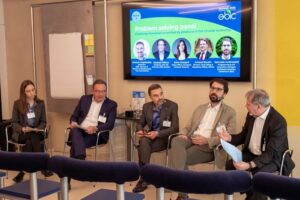
Antonis Angeletakis, with Jacques Pidoux, Aline Granjard, Arnaud Bouxin, and Samuele Ambrosetti
In the session on Beneficial Microorganisms and the Bioeconomy, moderated by Marco Rosso, panellists Ronan Kempf , Rosanna Pecere, Francisco Castro Alves, and Theodora Nikolakopoulou explored regulatory challenges for microbial products. They agreed that innovation is accelerating, but regulation remains out of step. EU-wide rules provide harmonisation but often lack flexibility, while national rules create confusion. The need for proportionate, predictable rules was strongly voiced, and panellists agreed on the potential benefits of similar microbial assessment frameworks across sectors that are adapted according to the final use of the product.

Marco Rosso and panellists Ronan Kempf , Rosanna Pecere, Francisco Castro Alves, and Theodora Nikolakopoulou
The third session, Empowering Farmers to Keep Pace with Innovation, featured Fotini Giannakopoulou, Mateusz Ciasnocha, and Miriam Pajares, moderated by Natasha Foote. The discussion centred on strengthening advisory services and farmer engagement in research. It was stressed that successful adoption depends not only on efficacy but also on trust, community, and shared learning.
Afternoon plenary: time-to-market challenges
The post-lunch plenary addressed regulatory barriers. Bianca Forte, Aaron Powers, Laurent-David Charbit, Ferran Soldevila , and Luis Vivas-Alegre discussed how lengthy EU approval processes deter investment. Forte shared how lack of regulatory clarity delayed her startup’s progress. Powers advocated for “regulatory sandboxes” to enable faster product trials, while Charbit stressed that products must be commercially viable within investor timelines. Soldevila highlighted the dilemma between national authorisations and EU conformity processes, which differ in speed and scope. Vivas-Alegre acknowledged the need for better coherence and agility in implementation.
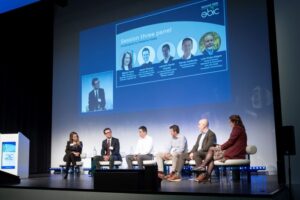
Bianca Forte, Aaron Powers, Laurent-David Charbit, Ferran Soldevila , and Luis Vivas-Alegre
Closing call to action
EBIC President Carlos Rodriguez-Villa Förster closed the day with a call to action, urging EU institutions to adopt regulation that enables innovators who respect quality and safety standards, to implement a criteria-based process for new micro-organisms in biostimulants, to revert to standard REACH requirements, and to establish a Circular Economy-aligned framework for animal by-products.
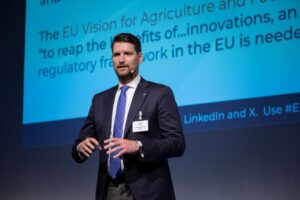
Carlos gives closing statements
“The EU must take its own advice,” he concluded. “Be bold. Take calculated risks.”
A full summary is available in EBIC’s post-Summit slide deck.
Fireside chat: thriving amid fragmentation
An exclusive post-Summit session for EBIC members brought together senior leaders from COMPO EXPERT, Syngenta, BioFirst Group, Agrauxine by Lesaffre and Rovensa Next for a panel discussion moderated by Natasha Foote. They reflected on barriers to farmer adoption and the need for shared sense-making across the sector. The discussion touched on the role of EBIC in education and communication, and how biostimulants must be seen as part of resilient agronomic systems. One participant summarised: “Biostimulants are not a cost. They are an investment in resilience.”
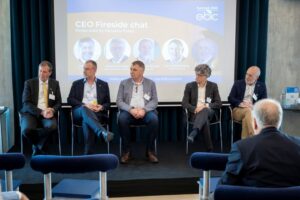
CEO Fireside Chat
Looking ahead
This year’s Summit underscored that innovation alone is not enough. Collaboration, coherence, and actionable regulation are critical to ensuring Europe leads in sustainable agriculture. EBIC remains committed to bridging science, policy, and practice to turn disruption into momentum.